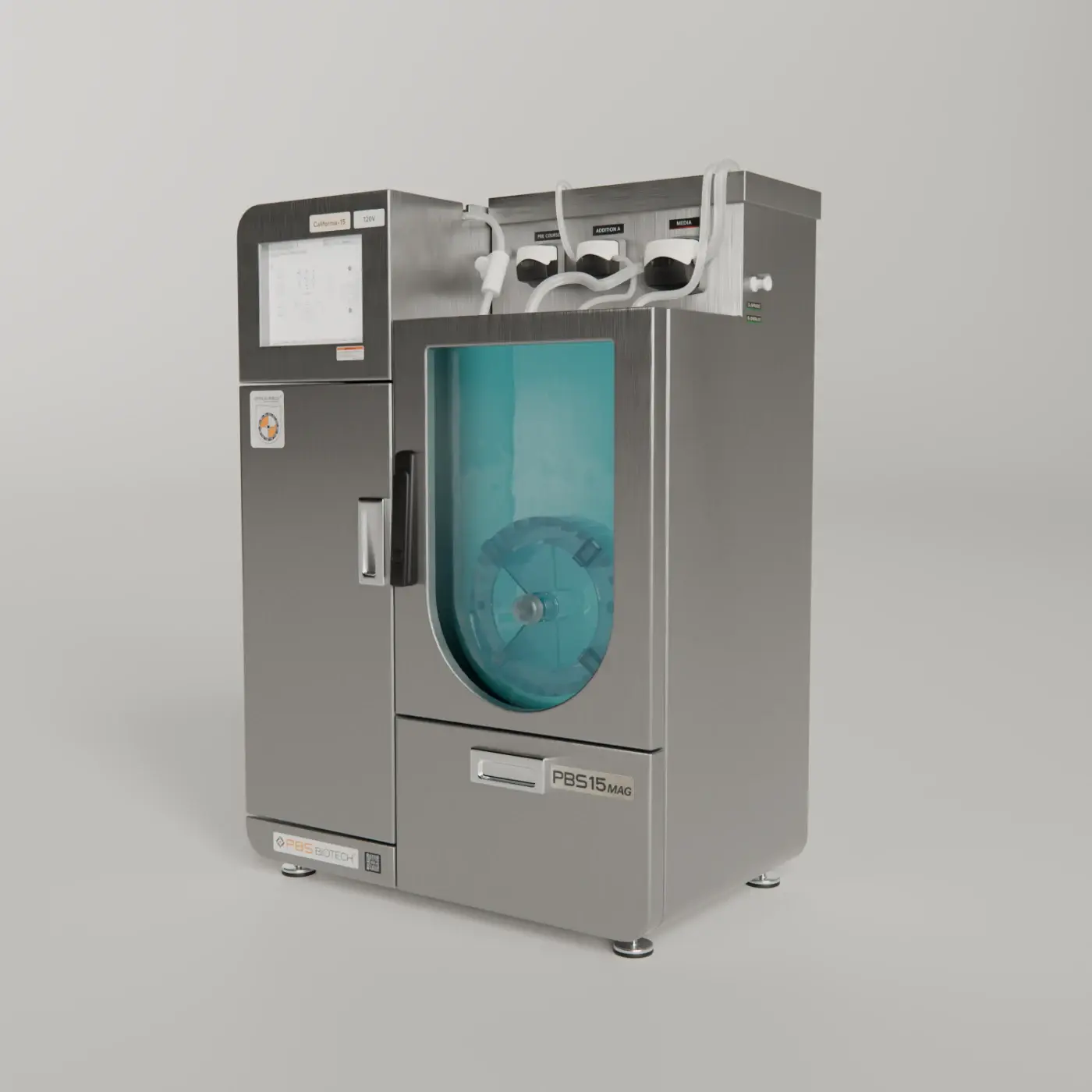
PBS-15
The first fully manufacturing-scale bioreactor using Vertical-Wheel® technology to scale proven processes for clinical and commercial needs. Generate larger batches, support clinical supply, and prepare for commercial scale on the next level of Vertical-Wheel bioreactors.

Why PBS-15
The PBS-15 is the next system on the clinical manufacturing scale. Once a process has been demonstrated at 3L scale with the PBS-3, the next challenge is producing enough cells to support clinical programs and commercial supply. The PBS-15 enables teams to increase batch size while maintaining the same Vertical-Wheel culture conditions, helping move from process development into routine manufacturing operations.
Produce clinically meaningful batches without changing platforms by maintain your proven Vertical-Wheel culture conditions.
Standardize every run with recipes, process control, and comprehensive data capture.
Designed for commercial manufacturing with single-use, cGMP-ready vessels and secure, audit-ready, 21 CFR Part 11-compliant software and IQ/OQ documentation.
Optimize an external ATF system to support high-density, closed system processing and intensified workflows.
The PBS-15 Vertical-Wheel FLUIDIX™ Vessel
The PBS-15 runs the pre-sterilized, single-use Vertical-Wheel FLUIDIX™ 15L vessel with the same wheel geometry as the systems below it, now at clinical batch scale.
Single-use sensors: measure, track, and control pH and DO through integrated optical sensors.
Proven With PBS-15
Published Vertical-Wheel data at this scale — protocols, app. notes, peer-reviewed papers, case studies, posters, webinars, etc.
This guide collects and summarizes process parameters from successful experiments performed in Vertical-Wheel® bioreactors, across a variety of cell types including pluripotent stem cells, mesenchymal stem/stromal cells, exosomes and extracellular vesicles, organoids, and immune cells. Find the publication or resource most relevant to your own experiment to help with your process development.
This poster reviews key process development considerations required to achieve robust, efficient, and scalable manufacturing of allogeneic cell therapies**.** The authors discuss major scale-up challenges including equipment selection, hydrodynamic control, oxygen transfer, medium exchange, and cell harvest operations. Case studies demonstrate how process optimization and Vertical-Wheel bioreactor technology can reduce seed train requirements, shorten manufacturing timelines, decrease facility footprint, and integrate closed-system operation. The work also presents methodologies for…
This poster describes linear scale-up of human induced pluripotent stem cell aggregate expansion across 0.1, 3, 15, and 80 L Vertical-Wheel bioreactors. A baseline small-scale process was used to establish operating conditions and assess reproducibility and robustness across media, operators, cell lines, and agitation rates. Perfusion-based media exchange was introduced at reactor scales of 3 L and above to address increasing settlement times and aggregate merging as vessel scale increased. Cell growth, aggregate size, metabolic consumption and production, and pluripotency markers were…
This poster presents a three-dimensional process for linear scale-up of human induced pluripotent stem cell expansion from 0.1 to 80 L in Vertical-Wheel® Bioreactors. Cultures maintained growth, aggregate sphericity, pluripotency, karyotype, and functional pluripotency across scales. Serial aggregate culture and scalable harvest, concentration, and cryopreservation generated high-density working cell banks that retained viability, growth, genomic stability, and differentiation competence after thaw. The banks supported shortened endocrine, islet-like, and cardiomyocyte workflows through…
This white paper examines the economic and operational advantages of Vertical-Wheel® Bioreactors compared with planar culture and conventional stirred-tank systems for cell therapy manufacturing. Key cost drivers include expansion efficiency, labor, facility footprint, process scalability, batch reproducibility, and product quality. Published examples demonstrate increased cell yield, fewer processing steps, reduced labor, and improved facility utilization through single-use, closed-system operation. Low-shear, homogeneous hydrodynamics support consistent growth and critical quality…
This application note describes an hMSC manufacturing workflow using RoosterBio cell products, xeno-free media, and PBS Biotech Vertical-Wheel bioreactors. Studies evaluated microcarrier culture, fed-batch operation, harvest, scale-up, and cell quality. The low-shear, uniformly mixed environment supported robust attachment and cell densities up to 500,000 cells/mL within five days. Fed-batch processing improved media productivity by eliminating routine media exchanges and reducing labor. Comparable growth and metabolite control were maintained across development, pilot, and production…
PBS-15 Parts - (selected parts are added to cart for quote requests)
Loading part numbers…
We Support You Every Step of the Way
Our application scientists help you get the most out of PBS-15, and help you plan for the steps that come next.
Our application scientists optimize cell yield and quality on PBS-15 with you.
Equivalent set points from PBS-15 to PBS-80, CFD-validated at every step.
Guided-optimization packages that move you from R&D to clinical scale.
Go Vertical, Today
Tell us what you need and we’ll take it from there.